
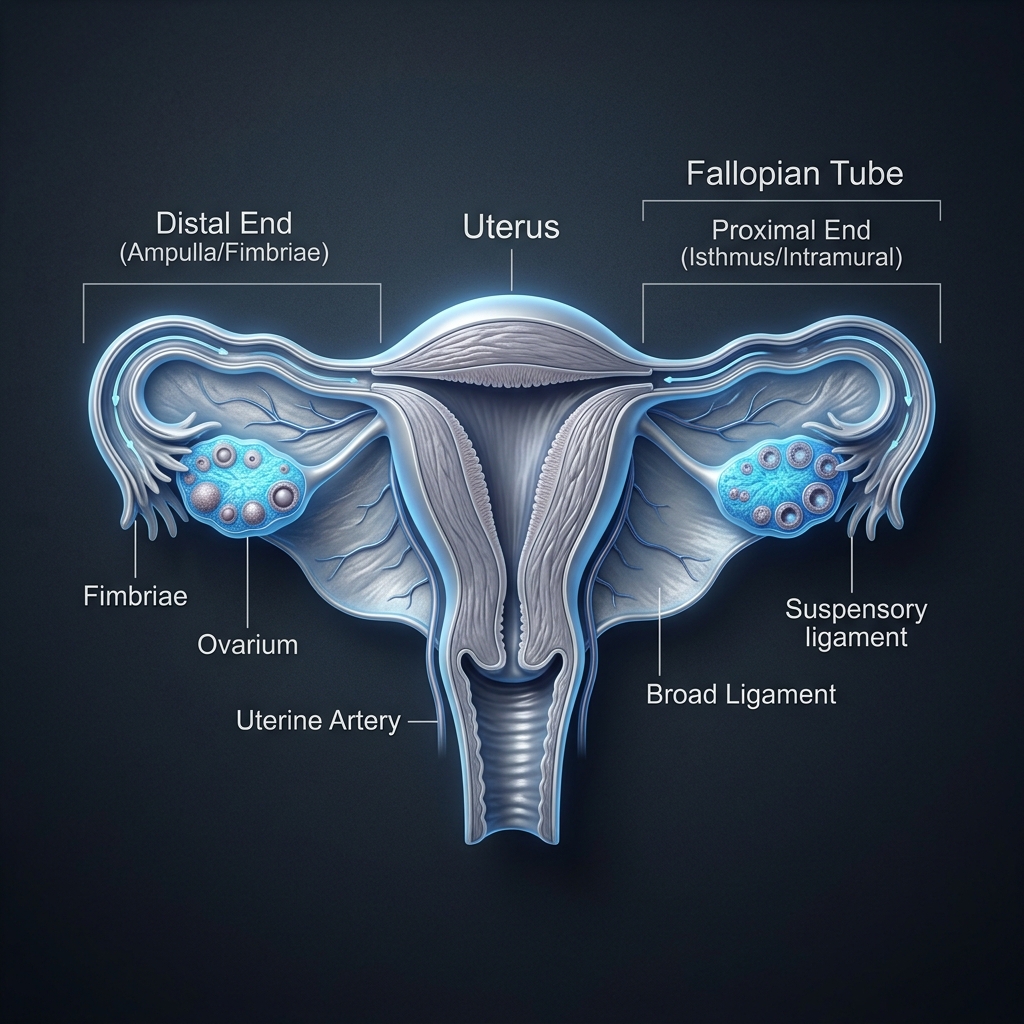
1. Definition and Anatomy of Tubal Disease
Tubal Factor Infertility (TFI) accounts for approximately 25% to 35% of all female infertility cases. It is characterized by anatomical blockage, luminal scarring, loss of mucosal ciliary function, or complete structural distortion of one or both fallopian tubes (oviducts), preventing normal sperm-egg interaction and transport of the fertilized blastocyst to the uterine cavity.
Anatomical Divisions of the Fallopian Tube
- Interstitial / Intramural Segment: Traverses the thick uterine myometrium.
- Isthmus: Muscular, narrow segment proximal to the uterus.
- Ampulla: Broad, thin-walled, convoluted intermediate segment—the primary anatomical site of human fertilization.
- Infundibulum & Fimbriae: Funnel-shaped distal terminus with mobile, finger-like projections responsible for capturing the ovulated oocyte from the ovarian surface.
2. Etiology & Risk Factors
- Post-Infectious Salpingitis: Ascending STI pathogens (specifically Chlamydia trachomatis producing heat shock protein 60, triggering chronic autoimmune mucosal scarring).
- Hydrosalpinx: Distal occlusion of the fimbrial end resulting in progressive distension of the tube with sterile, toxic serous fluid.
- Endometriosis: Fibrotic pelvic implants causing tubal distortion, peritubal adhesions, and fimbrial agglutination.
- Pelvic Surgery Complications: Prior appendectomy, myomectomy, or bowel surgery leading to pelvic adhesions.
- Genital Tuberculosis: Granulomatous salpingitis causing dense calcification and rigid, non-functional "lead-pipe" tubes.
3. Understanding Your Diagnostic Reports: The HSG & Laparoscopy
========================================================================================
HYSTEROSALPINGOGRAPHY (HSG) & HYSTEROSALPINGO-CONTRAST SONOGRAPHY (HyCoSy) INTERPRETATION

TEST OVERVIEW: Radiopaque water-soluble iodinated contrast medium is infused through a
transcervical cannula under continuous fluoroscopic X-ray visualization.

1. NORMAL (PATENT) HSG FINDINGS
├─ Uterine Cavity: Smooth, inverted triangular contour without filling defects.
├─ Tubal Lumina: Symmetrical, slender opacification across isthmus and ampulla.
└─ Peritoneal Spill: Immediate, free, unrestricted dispersion of radiopaque dye
   diffusing around pelvic bowel loops and pouch of Douglas bilaterally.
2. ABNORMAL (PATHOLOGICAL) HSG FINDINGS
├─ Proximal Tubal Occlusion (PTO): Contrast abruptly halts at the cornual junction;
│  no dye enters the isthmus (can be true fibrosis or transient cornual spasm).
├─ Distal Tubal Occlusion (DTO): Complete filling of the tube with failure of peritoneal spill.
├─ Hydrosalpinx: Massive, clubbed, dilated ampullary segment ("retort-shaped" pouch)
│  with retention of stagnant contrast material.
├─ Loculated Peritoneal Spill: Contrast pooling in fixed pockets, indicating peritubal adhesions.
└─ SIN: Multiple small diverticular outpouchings along the isthmus.
========================================================================================
========================================================================================
GOLD STANDARD: DIAGNOSTIC LAPAROSCOPY WITH CHROMOPERTUBATION

Procedure: Direct visual inspection of pelvic organs while injecting dilute Methylene Blue
or Indigo Carmine dye through the cervix.

* Direct observation of dye exit (fimbrial spill).
* Definitive staging of peritubal adhesions, endometriosis, and ovarian mobility.
========================================================================================
4. Surgical Interventions & Reconstructive Microsurgery
                       TUBAL SURGICAL OPTIONS
                                 │
     ┌───────────────────────────┴───────────────────────────┐
     ▼                                                       ▼
PROXIMAL OBSTRUCTION                                    DISTAL OBSTRUCTION / HYDROSALPINX
└── Selective Tubal Cannulation                         ├── Fimbrioplasty (De-agglutination)
    (Fluoroscopic/Hysteroscopic)                        ├── Salpingostomy (New distal ostium)
                                                        └── Salpingectomy (Excision prior to IVF)
- Selective Hysteroscopic/Fluoroscopic Tubal Cannulation: Insertion of a fine guidewire and balloon catheter through the uterine cavity into the tubal ostium to clear proximal amorphous debris or break delicate cornual synechiae.
- Fimbrioplasty: Microsurgical separation of adherent fimbrial folds and dilatation of a stenotic fimbrial opening, preserving natural anatomical architecture.
- Salpingostomy (Neosalpingostomy): Creation of an entirely new opening in an ampullary segment fully occluded by distal hydrosalpinx.
- Laparoscopic Salpingectomy: Complete excision of a diseased hydrosalpinx. Critical Clinical Note: Hydrosalpinx fluid contains inflammatory cytokines and prostaglandins toxic to developing embryos; removing or clipping the affected tube prior to IVF improves embryo implantation and pregnancy rates by over 50%.
5. Assisted Reproductive Technology (ART): IVF vs. Surgery Decision Matrix
| Clinical Parameter | Reconstructive Tubal Surgery | In Vitro Fertilization (IVF) |
|---|---|---|
| Patient Age | Ideal for < 35 years with good ovarian reserve | Preferred for ≥ 35 years or low ovarian reserve |
| Tubal Status | Mild distal disease, thin-walled hydrosalpinx (< 15 mm) | Severe bilateral hydrosalpinx (> 25 mm), dense adhesions |
| Conception Potential | Enables spontaneous cyclical conception attempts | Requires individual stimulated treatment cycles |
| Ectopic Pregnancy Risk | Elevated post-surgery (5% to 15%) | Significantly lower (though still ~2%) |
| Male Factor Infertility | Normal semen parameters required | Overcomes concurrent severe male subfertility (via ICSI) |
6. Frequently Asked Questions (FAQ)
Q1: Can a blocked fallopian tube unblock on its own?
True anatomical blockages caused by fibrous scar tissue or infectious damage do not resolve on their own. However, apparent blockages caused by transient cornual muscle spasms during a painful HSG test can disappear on repeat evaluation with antispasmodics.
Q2: Is an HSG test painful?
Patients often experience moderate menstrual-like cramping when the cervical cannula is placed and the contrast fluid distends the uterus and tubes. Taking an oral NSAID (such as Ibuprofen 400–600 mg) 45 minutes prior to the procedure significantly reduces discomfort.